






Instructor Inspiration
We asked our SAO Instructors what inspired them to follow a career in astronomy. Here are their responses.
Giovanna Pugliese
I do not remember the first time I showed my interest in astronomy. According to my mother when I started school at 5 years old, I was already interested in whatever was shining there high in the sky, and at 9 years old I said to everybody that I wanted to study "like Galileo"! That was the beginning of the '80s, and it was difficult for many people to take seriously the plans of a such young girl. In that period, there were few women in astronomy. But astronomy was my passion, and step by step I carried on my dream and love for stars, making astronomy my profession. A profession which brought me around the world, and which allows me to learn new things, and meet interesting people day by day.
Terry Bridges
So I had been interested in science since I was in middle school, but I can point to one specific moment that got me into astronomy. That was in high school when two astronomers came to my small town in northern Alberta with telescopes and a mobile planetarium. Once I saw Saturn through a telescope for the first time, and talked with the astronomers, I got hooked. I remember spending many nights that summer gazing up at the sky. I think I was also inspired by the dark skies and northern lights.
Sarah Maddison
I liked all sciences and maths in school, so I was pretty interested in just about everything. Dissecting a frog turned me off the "wet" sciences, and I thought astronomy was pretty amazing after learning in maths class that you could describe the orbits of planets around the Sun with two very simple equations, and learning in chemistry that all elements in the periodic tables (besides H and He) were made in stars. When I went to university I still wasn't sure which science to major in. I really enjoyed palaeontology and geophysics for a while, but continued on with applied maths. By the time I was in the final year of my Bachelors, I was doing all the astrophysics and meteorology units offered in maths. When it came to my honours year, I finally had to choose between meteorology and astrophysics. A friend said to me, "Well if you do meteorology, people will always blame you for the bad weather", so astrophysics it was!
Karl Glazebrook
I had a long term interest in space and space flight (I was a boy astronaut) and read a lot of Arthur C. Clarke books (his fiction and non-fiction about the realities of exploring the solar system). From that I graduated to Patrick Moore (who also wrote some SF) and a more general interest in astronomy and then had a small telescope with which I looked at the Moon and planets - this was when I was about 10. I also read a LOT of SF as well as science books. My interests then changed more to high-end physics and I studied physics at University. I wanted to be a theoretical physicist dreaming up TOEs (Theory of Everything) but after a course in quantum field theory in my final undergraduate year I realised I wasn't smart enough for this! So I ended up doing a Ph.D. in astronomy as it seemed to offer the opportunity to travel to exotic places like Hawaii, Chile and Australia. Seems to have worked out...
Chris Fluke
My interest in space and astronomy began at an early age, and was a combination of a number of factors. Three particularly profound events stand out in my memory: Christmas 1978, when my parents gave me some toys from a little movie called "Star Wars"; Carl Sagan's "Cosmos" television series in the early 1980s; and a trip to the original H.V.McKay Planetarium at the Melbourne Museum a few years before the most recent return of Halley's Comet. It was this last event that made me realise you could get actually get paid for looking at the night sky! Add in "Doctor Who", "Battlestar Galactica "and various other science fiction television shows, "The Hitch-Hikers Guide to the Galaxy" trilogy (in an increasing number of parts), visits to the Old Melbourne Observatory, early attempts at astrophotography with my father's SLR camera, writing simple astronomy programs on the family's TSR-80 colour computer, and a couple of research projects on "Mars" and "Saturn" at high school - and it was inevitable that I would go on to study...Software Engineering as part of a double degree at Melbourne University. After this brief detour, I returned my attention solely to Physics, completing my Honours year and PhD at the University of Melbourne (1999), before joining the new-born Centre for Astrophysics & Supercomputing at Swinburne University.
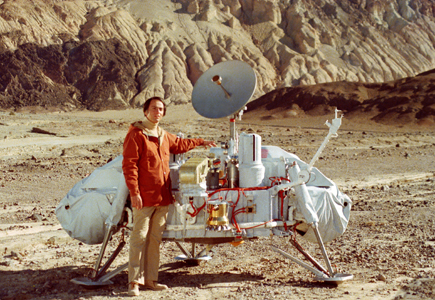
Carl Sagan with a model Viking lander in Death Valley, California. (Credit: NASA/JPL)

