
Apparent Magnitude
The apparent magnitude of a celestial object, such as a star or galaxy, is the brightness measured by an observer at a specific distance from the object. The smaller the distance between the observer and object, the greater the apparent brightness.
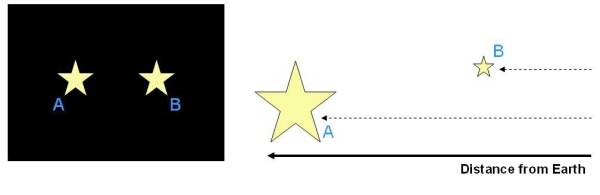
Two objects that have the same apparent magnitude, as seen from the Earth, may either be:
- At the same distance from the Earth, with the same luminosity.
- At different distances from the Earth, with different values of luminosity (a less luminous object that is very close to the Earth may appear to be as bright as a very luminous object that is a long distance away).
To convert the apparent magnitude, m, of a star into a real magnitude for the star (absolute magnitude, M), we need to know the distance, d to the star. Alternatively, if we know the distance and the absolute magnitude of a star, we can calculate its apparent magnitude. Both calculations are made using:

with m – M known as the distance modulus and d measured in parsecs.
The apparent magnitudes, absolute magnitudes and distances for selected stars are listed below:
| Star | mv | Mv | d (pc) |
|---|---|---|---|
| Sun | -26.8 | 4.83 | 0 |
| Alpha Centauri | -0.3 | 4.1 | 1.3 |
| Canopus | -0.72 | -3.1 | 30.1 |
| Rigel | 0.14 | -7.1 | 276.1 |
| Deneb | 1.26 | -7.1 | 490.8 |
Although Rigel and Deneb have the same real brightness (the same absolute magnitude), Rigel appears brighter than Deneb on the sky (it has a smaller apparent magnitude) because it is much closer to the Earth.
Study Astronomy Online at Swinburne University
All material is © Swinburne University of Technology except where indicated.