
Solar Day
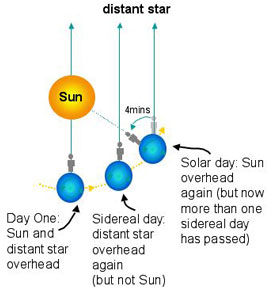
A solar day is the time it takes for the Earth to rotate about its axis so that the Sun appears in the same position in the sky. A sidereal day is the time it takes for the Earth to rotate about its axis so that the distant stars appear in the same position in the sky. The solar day is ~4 minutes longer than the sidereal day.
Although a simple definition of a day is the time it takes for a planet, satellite or other celestial body to complete one rotation about its axis, two alternative definitions exist. The sidereal day is measured with respect to the stars, while the solar day is the length of time measured from noon to noon. By noon, we mean the time when the Sun passes the celestial meridian, reaching its maximum height in the sky.
As the Earth turns on its rotation axis, it also moves along its orbit around the Sun. This means that the time between successive noons is slightly longer (by about 4 minutes) than the actual rotation period of the planet. In addition, the Earth does not move at a constant speed throughout its orbit, so the apparent motion of the Sun along the ecliptic changes speed from day to day.
To simplify this situation, a fictitious mean Sun is introduced. This is identical to a Sun that was moving at a constant speed along the celestial equator (rather than the ecliptic). The speed chosen is the average speed of the Sun’s ecliptic motion, leading to a mean solar day of 24 hours.
Study Astronomy Online at Swinburne University
All material is © Swinburne University of Technology except where indicated.