
Meteor Stream
A meteor stream is a relatively narrow band of meteoroids stretched out along the orbital path of a comet.
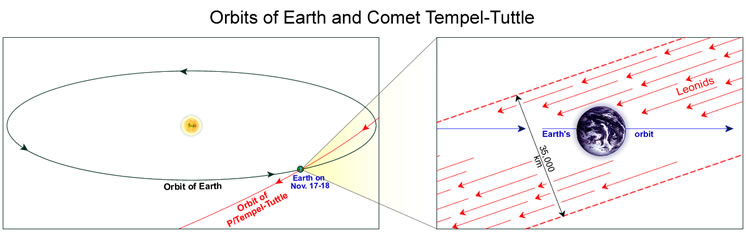
A meteor stream consists of dust released from the nucleus of a comet during its perihelion passage. Slight differences in the resultant orbital periods cause the individual dust grains to spread out along the orbital path of the parent comet. If the Earth’s orbit intersects the meteor stream, a meteor shower is observed.
Within about 3 AU from the Sun, a comet is heated sufficiently so that the ices making up the nucleus begin to sublimate. As this gas is released from the nucleus, it carries with it small, solid dust grains (meteoroids) which can escape the weak gravity of the nucleus to travel on their own independent, heliocentric (Sun-centred) orbits. Although these orbits remain similar to that of the parent comet, the different velocities at which they were ejected from the nucleus give them slightly different semi-major axes and orbital periods. This results in the gradual spread of the meteoroids along the cometary orbit to form a ‘stream’ of material.
Meteor streams are relatively short-lived phenomena with most only lasting of order 10,000 years. They are dispersed by radiation pressure, collisions between the meteoroids, and gravitational perturbations and collisions with other planets. In particular, the Earth passes through several meteor streams during the course of its orbit around the Sun. Whenever this happens, we observe a meteor shower.
Study Astronomy Online at Swinburne University
All material is © Swinburne University of Technology except where indicated.