Adapted from an article in VicNews, Sept. 2000
Cosmic Beacons
Victoria University Senior Research Fellow Glen Mackie is measuring the Universe. His cosmic yardsticks are highly luminous Brightest Cluster Galaxies (BCGs), the largest galaxies in the Universe. The research has important implications for galaxy formation and evolution as well as providing an independent way to determine distances and large-scale motions of galaxies in the early Universe.
Dr Mackie of the School of Chemical and Physical Sciences is using high resolution Hubble Space Telescope (HST) imaging data. Charge Coupled Device (CCD) images using the Wide Field Planetary Camera 2 (WFPC2) instrument allows detailed structural and brightness measurements of the faint, distant BCGs.

Figure 1: Hubble Space Telescope in the Space Shuttle bay
during a refurbishment mission. An astronaut is near the top
of the telescope.
BCGs are so large that 100 Milky Ways (the galaxy we reside in) end to end could easily fit inside one BCG. BCGs dominate the centre of richly populated clusters of galaxies that can have anywhere from 100 to 1000 galaxy members. The BCGs large luminosities allows them to be viewed across cosmologically significant distances of the Universe.
Why are these galaxies important though? Previous studies of close-by BCGs have shown that they possess a remarkably narrow range of luminosities. By assuming all BCGs have the same absolute brightness and then measuring their apparent brightness their distance can be calculated. However, these nearby BCGs are only(!) 0.5 billion light years away. Our Universe is much larger, approximately 15 billion light years in size. Hence these close-by BCGs only sample relatively small volumes of the Universe.
A previous study also produced startling results regarding the motion of galaxies based on close-by BCGs. They find that the motion of the Local Group of galaxies (that includes our Milky Way and about 30 other galaxies) is not in agreement with a standard frame of reference inferred from the Cosmic Background Radiation. Simply put, the bulk motion of the Local Group appears to be influenced by large mass concentrations at distances larger than 0.5 billion light years.
"If this result holds it has important consequences for the large scale structure in the Universe. Most favoured cosmological models require that large regions of the Universe should look homogeneous. It is assumed that on the largest scales the motions of galaxies will be dominated by the general expansion of the Universe with little influence from any local dense regions of space," Dr Mackie explained.
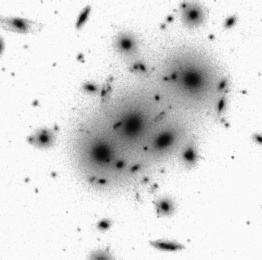
Figure 2: The central region of the rich cluster 0024+1654 showing
the central BCG (about 5 billion light years distant).
The image is shown inverted with black corresponding to high light intensity.
(Credit W.N. Colley and E. Turner (Princeton University),
J.A. Tyson (Bell Labs, Lucent Technologies) and NASA).
The intention of this Marsden funded research is to investigate the properties of more distant BCGs (ranging between 1 and 8 billion light years distant) to determine if they could also be used for similar studies. In July Dr Mackie presented results from HST data at the annual Astronomical Society of Australia meeting in Hobart.
"The HST results show that more distant BCGs also have a very narrow range of luminosities. BCGs appear to be a very special, homogeneous family of galaxies that form quite quickly, early in the lifetime of the Universe, and then evolve very slowly in luminosity thereafter."
"The HST observed BCGs should provide distances accurate to about 20%. If we can now put together a large sample that gives a good all-sky coverage, we can utilise their unique properties to accurately study bulk flows out to about 5 billion light years. The ultimate use of these BCGs would be to form a better standard of reference against which the bulk motion of the Local Group could be measured. Any significant deviations between this motion and that inferred from the Cosmic Background Radiation would pose major problems to present cosmological models."
This type of distant Universe research is novel for New Zealand. Dr Mackie said that this research highlights that it is not necessary to be near large telescopes in order to do extra-galactic research on distant objects.
"Future research will increasingly be done by queue-scheduling many different research projects in one night, with data being sent to observers by the Internet. Importantly New Zealand graduates can now get exposure to extra-galactic research, that is an increasingly large part of all astrophysics research in the world."
For further information - Email: gmackie@swin.edu.au Web: Glen Mackie Centre for Astrophysics and Supercomputing

Last updated: 20-Dec.-2001