
Galactic Filaments
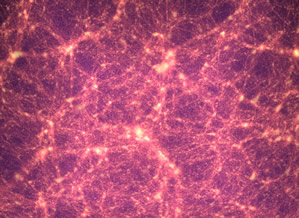
A distribution of galaxies simulated using the Swinburne supercomputer. Each individual dot represents a single galaxy, and long filaments made up of thousands of galaxies are clearly visible. The bright regions at the intersections of filaments are potential galaxy superclusters.
Credit: Paul Bourke and Alexander Knebe, Swinburne University of Technology
Credit: Paul Bourke and Alexander Knebe, Swinburne University of Technology
Observations of galaxies show that on large scales, they are not randomly distributed in the Universe. Most are found in groups and clusters which are themselves part of large-scale structures such as sheets and filaments. These structures contain millions of galaxies and are separated by large voids in which very few galaxies are found.
With lengths of hundreds of millions of light years (but thicknesses of only ~20 million light years), galactic filaments are some of the largest known structures in the Universe, and are partially responsible for the ‘honey-comb’ appearance evident in the image opposite. These large-scale structures are thought to be formed by the hierarchical clustering of galaxies around primordial density fluctuations (quantum mechanical fluctuations in the density of the Universe in the very first moments following the Big Bang). This means that in addition to revealing a great deal about the present day Universe on the largest scales, they also tell us something about processes on the very smallest scales in the very early Universe.
Study Astronomy Online at Swinburne University
All material is © Swinburne University of Technology except where indicated.