
Electromagnetic Spectrum
The electromagnetic spectrum (EMS) is the general name given to the known range of electromagnetic radiation. Wavelengths increase from approximately 10-18 m to 100 km, and this corresponds to frequencies decreasing from 3 × 1026 Hz to 3 ×10³ Hz.
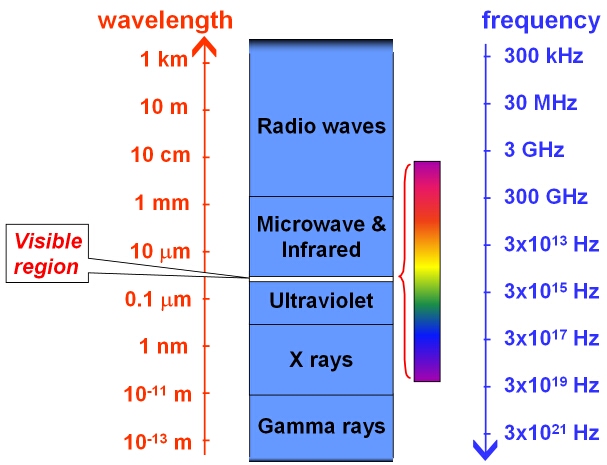
The image below shows the names given to different regions of the EMS. Note that the visible part of the spectrum, the only type of electromagnetic radiation that we can detect with our eyes, makes up only a tiny fraction of the EMS.
In a vacuum, all electromagnetic waves travel at the speed of light: c = 299,792,458 m/s. An energy ( E ) can be associated with each region of the EMS using the equation:

where f is the frequency and h is Planck’s constant which has the value:

The table below lists typical wavelengths, frequencies and energies for different regions of the EMS.
| Region | Wavelength | Frequency | Energy |
|---|---|---|---|
| Hard gamma | 1 × 10⁻⁹ nm | 3 × 1026 Hz | 1.2 × 10¹² eV |
| Gamma | 1 × 10⁻⁶ nm | 3 × 10²³ Hz | 1.2 GeV |
| Gamma/X-ray | 0.001 nm | 3 × 10¹⁹ Hz | 12 MeV |
| X-ray | 1 nm | 3 × 10¹⁷ Hz | 120 keV |
| X-ray/Ultraviolet | 10 nm | 3 × 10¹⁶ Hz | 12 keV |
| Ultraviolet | 100 nm | 3 × 10¹⁵ Hz | 1.2 keV |
| Visible (blue) | 400 nm | 7.5 × 10¹⁴ Hz | 3.1 eV |
| Visible (red) | 700 nm | 4.3 × 10¹⁴ Hz | 1.8 eV |
| Infrared | 10000 nm | 3 × 10¹³ Hz | 0.12 eV |
| Microwave | 1 cm | 30 GHz | 1.2 × 10⁻⁴ eV |
| Microwave/Radio | 10 cm | 3GHz | 1.2 × 10⁻⁵ eV |
| Radio | 100 m | 3 MHz | 1.2 × 10⁻⁸ eV |
| Radio | 100 km | 3 kHz | 1.2 × 10⁻¹¹ eV |
Study Astronomy Online at Swinburne University
All material is © Swinburne University of Technology except where indicated.