
Large-scale Structure
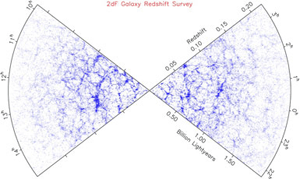
The 2dF galaxy redshift survey measured the distances to hundreds of thousands of galaxies in the (relatively) nearby Universe. The large-scale structures of sheets, filaments, voids and galaxy superclusters are clearly visible, and give this region of space a honeycomb appearance.
Credit: M. Colless (ANU) and the 2dF Galaxy Redshift Survey
Credit: M. Colless (ANU) and the 2dF Galaxy Redshift Survey
The Universe exhibits structure over a wide range of physical scales – from satellites in orbit around a planet through to the galaxy superclusters, galactic sheets, filaments and voids that span significant fractions of the observable Universe. These latter are commonly referred to as the ‘large-scale structure’ of the Universe, and are clearly observed in galaxy redshift surveys such as the Australian-led 2 degree Field (2dF) project (right).
In the local Universe, there are two large-scale structures of particular importance: the Great Wall and the Great Attractor. These structures influence the motions of galaxies in the Local Group, and are ultimately responsible for the fate of the Milky Way. Astronomers believe we will eventually merge with the Virgo cluster which will itself merge with the Centaurus and Shapley superclusters which make up the Great Attractor.
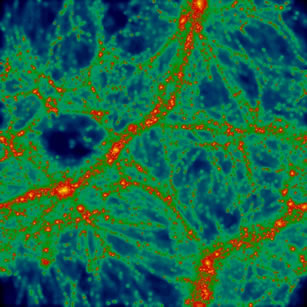
A cold, dark matter simulation of the large-scale structure in the nearby Universe. This image is ~800 million light years square. Red regions show high concentrations of galaxies, including galaxy superclusters and filaments, while blue areas show low galaxy concentrations in the voids.
Credit: Chris Power, Swinburne University
Credit: Chris Power, Swinburne University
From the point of view of cosmologists, large-scale structure is extremely important for two main reasons:
- It places severe constraints on cosmological models, the credibilities of which are partially determined by how well the observed large-scale structure is reproduced both now and at early times.
- It provides one of few means by which astronomers can probe conditions before the epoch of recombination in the very early Universe, and informs us about the quantum mechanical effects important at that time.
The cosmological model currently favoured is the cold dark matter (λ CDM) model. Supercomputer simulations (left) show that this model is able to reproduce the observed large-scale structure at the right time and on the correct scales to remarkable accuracy, provided we assume that the very early Universe did not have a perfectly uniform density. These tiny primordial density fluctuations are thought to arise from quantum mechanical effects, and are not only required to produce the large-scale structure, but also the observed Cosmic Microwave Background.
If this model is correct, it means that the largest structures in the Universe were initially seeded by events on scales smaller than the size of an atom in the fleeting instants immediately following the Big Bang.
Study Astronomy Online at Swinburne University
All material is © Swinburne University of Technology except where indicated.