
Jovian Planet
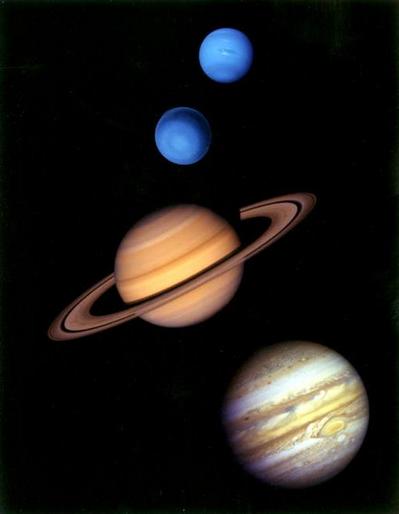
The giant planets of the outer solar system (Jupiter, Saturn, Uranus and Neptune) are often referred to as ‘Jovian planets’. This term literally means Jupiter-like, and although exploration of the Solar System over the past few decades has revealed that Uranus and Neptune in particular bear little resemblance to Jupiter (they are better described as ‘ice giants’), the name persists. It is often used to contrast these massive planets with the inner Earth-like or terrestrial planets: Mercury, Venus, Earth and Mars.
The term ‘Jovian’ is also now commonly used in the study of extrasolar planets to describe the Jupiter-mass planets found in these systems.
Study Astronomy Online at Swinburne University
All material is © Swinburne University of Technology except where indicated.