

Fossil Groups
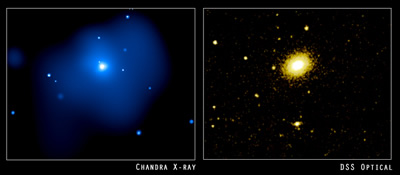
Fossil groups consist of a large, isolated elliptical galaxy embedded in an extended halo of X-ray emitting gas the size of a galaxy group. They are thought to result from the extensive merger of all the galaxies contained within a small group, with the extended X-ray halo providing strong evidence for the group origin.
The central elliptical galaxy in a fossil group is as bright as a brightest cluster galaxy, but does not possess the extended stellar halo often associated with such cluster galaxies. Despite the presence of this massive galaxy, the luminous material within a fossil group only accounts for ~10% of the mass in the system. The remaining mass (thought to exist as dark matter in a dark halo) is required to keep the hot ( ~ 10 million Kelvin) X-ray emitting gas gravitationally bound to the system.
Study Astronomy Online at Swinburne University
All material is © Swinburne University of Technology except where indicated.