
Core-collapse Progenitors
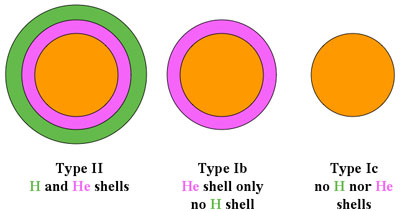
SNIb, SNIc and SNII all result from the core-collapse of a massive star. The differences arise depending on whether the progenitor has lost, or retains its hydrogen and helium shells before the explosion.
Type Ib (SNIb), Type Ic (SNIc) and Type II (SNII) supernovae are all thought to have similar origins – i.e. they all result from the core-collapse of a massive star. Support for this theory comes from the observation that all of these types of supernova are only found in or near spiral arms and HII regions in spiral galaxies. These are regions where active star formation is taking place and where massive stars exist. That no core-collapse supernova has ever been discovered in an elliptical galaxy indicates that they do not result from the explosion of an old, population II star. Other evidence, is that SNIb and SNIc show mostly intermediate mass elements in their late-time spectra, and some supernovae have been found to transition from SNII to SNIb as they evolve.
The key difference between the progenitors for the three types of core-collapse supernovae is the presence or absence of the outer hydrogen and helium shells before the explosion. SNII retain both their hydrogen and helium shells, resulting in the clear detection of hydrogen emission in their spectra. The almost featureless SNIc fall at the other end of the line, and appear to have lost both their hydrogen and helium envelopes through some mechanism prior to the explosion. In the middle we have SNIb, which have retained their helium envelope but appear to have lost their hydrogen envelope prior to the explosion. For this reason we do not observe hydrogen lines in the spectra of these objects but we do observe helium lines.
Exactly how the hydrogen and helium envelopes are lost remains unclear, however, it could be due to mass transfer in a close binary system, through a common envelope phase, strong stellar winds or a combination of all these possibilities. That some of the mass of the progenitor star is lost before the core-collapse is not in doubt since SNIb and SNIc are detected at radio wavelengths indicating that they are surrounded by circumstellar material.
Study Astronomy Online at Swinburne University
All material is © Swinburne University of Technology except where indicated.