
The B filter is centred at a
wavelength of 450 nanometers (nm, where 1nm = 10-9 m) and I
is centred at 820 nm.
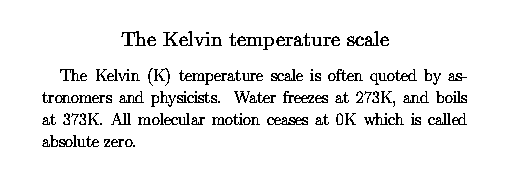
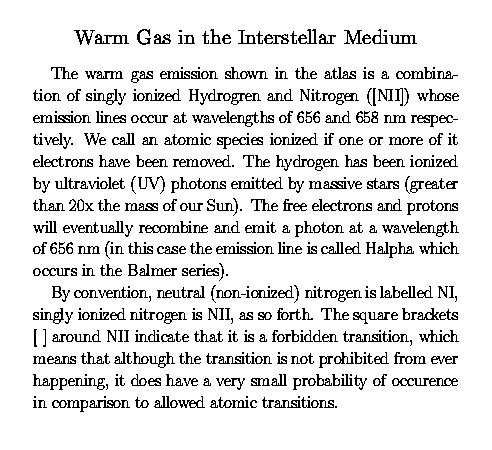
As well some galaxies have regions of 104 degree Kelvin (K) ionized gas, that astronomers call warm gas . This gas is usually associated with regions of star formation, and hence will be seen in many spiral galaxies. These warm gas regions will be seen in the optical Halpha+[NII] images of the atlas.
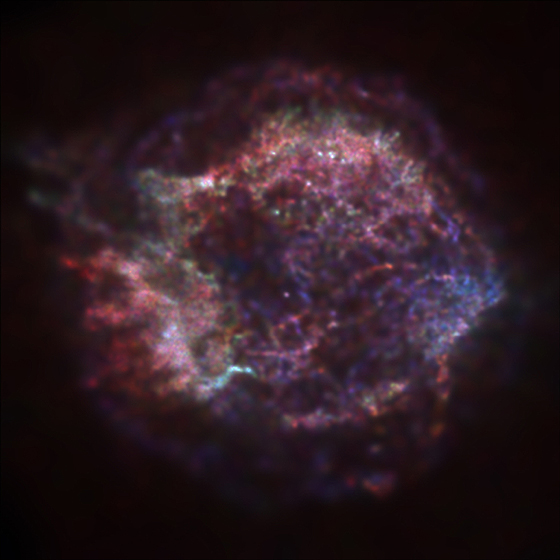
Thermal emission (107 K hot gas) associated
with supernova remnants (SNRs) is
also a component of X-ray emission.
|
Chandra X-ray Observatory image of the supernova remnant Cassiopeia A (Cas A) |
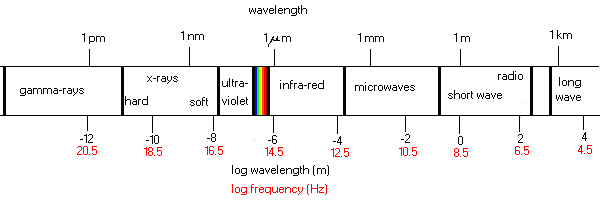
Many elliptical galaxies possess hot gas halos (107 K) and appear to contain emission from XBs as well. The X-ray emission shown in this atlas has energies of 0.2-2.0 keV, whose emission wavelength ranges from 6 - 0.6 nm.
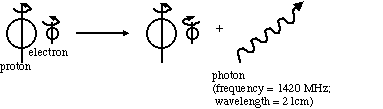
The atlas also shows 20 cm images, which has radiation at a frequency of 1.49 GigaHertz. [Radio astronomers tend to quote both wavelength and frequency of observations!]
This continuum
emission can consist of both synchrotron
emission (radiation emitted by electrons accelerated by a magnetic
field) ...
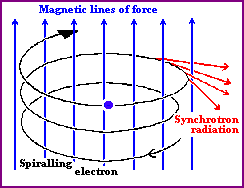
... and emission from ionized hydrogen (HII) regions. In spirals the synchrotron emission can be the dominant component at 1.49 GHz and arise from relativistic electrons whose origin is probably SNRs. The radio emission at 20 and 21 cm occurs at 20 and 21 x 107 nm respectively.
 Infrared
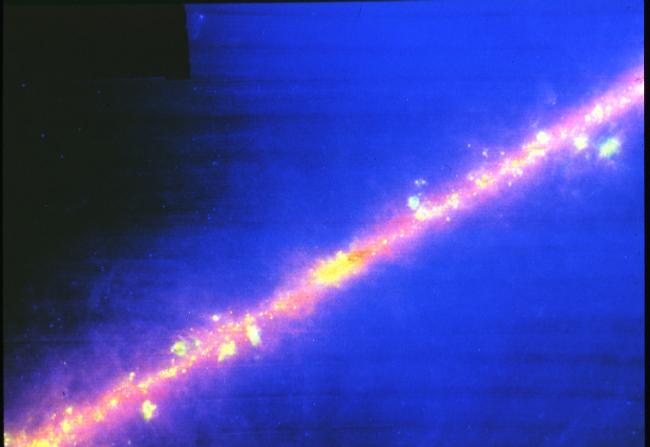
image of the centre of the Galaxy
Infrared
image of the centre of the Galaxy