SAO Project 48 Information
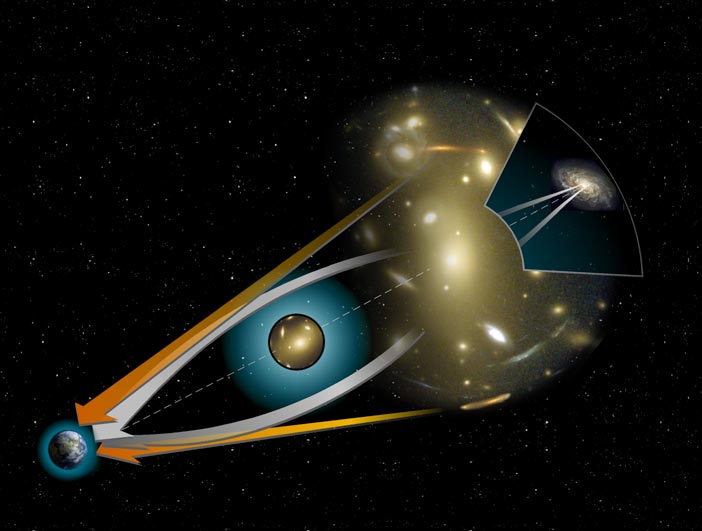
A schematic showing an example of strong lensing - the cluster of galaxies Abell 2218 imaged by HST/WFPC2. Credit: NASA, Andrew Fruchter and the ERO Team [Sylvia Baggett (STScI), Richard Hook (ST-ECF), Zoltan Levay (STScI)] (STScI)
Project #48. Gravitational Lensing
Since the first positive identification that mass deflects light in 1919, gravitational lensing has grown into incredibly valuable tool for studying Dark Matter. In this project, discuss the various searches for Dark Matter using gravitational lensing both within or Galaxy, the Milky Way, and beyond our Galaxy.Science fiction 20 years ago, reality today.Below I list some web sites and reference books to get you started. The books are not to be regarded as "must buy". They are not required reading for each project, because there is no required reading! I list well known books that I hope can be found in libraries.
I am happy to comment on a summary of what you intend to do (in fact please send me a summary as soon as possible so I know you are on track).
Caution! The Internet
Internet search engines are listed below the Projects. A word of warning/caution to users of Internet/Web resources. Just because information is on a Web page, doesn't mean that it is correct. After a while you will be able to identify the more reputable sites (eg. most .edu, .ac sites). Check the credentials of the author of the site. Has the web site been updated lately? Does it agree with other (non-Internet) information?The truth is out there, but so is a lot of rubbish!
Some good links, BUT, always be wary of any internet site that ends with .com !!
Pete Newbury - Langara College - Vancouver
Fort and Mellier - Ann. Review Article - 1994
Magazine: Scientific American, J. Wambsganss, "Gravity's Kaleidoscope", November 2001 issue.
Astronomy Resources
Astro-ph (electonic pre-prints) * NASA ADS
Resource Lists * Astronomical Resources on the World Wide Web: A Guide to Surfing
Internet Search Engines
Google * HotBot * MetaCrawler
General References
CNN Space * Astronomy * Sky and Telescope * Scientific American * New Scientist * New Scientist Astronomy Links
Back to
Swinburne Astronomy Online